How structured products went from niche curiosity to 8,000 new filings a month — and why almost nobody is paying attention.
We're going to tell you about something happening in financial markets right now that almost nobody outside a very specific corner of Wall Street is talking about.
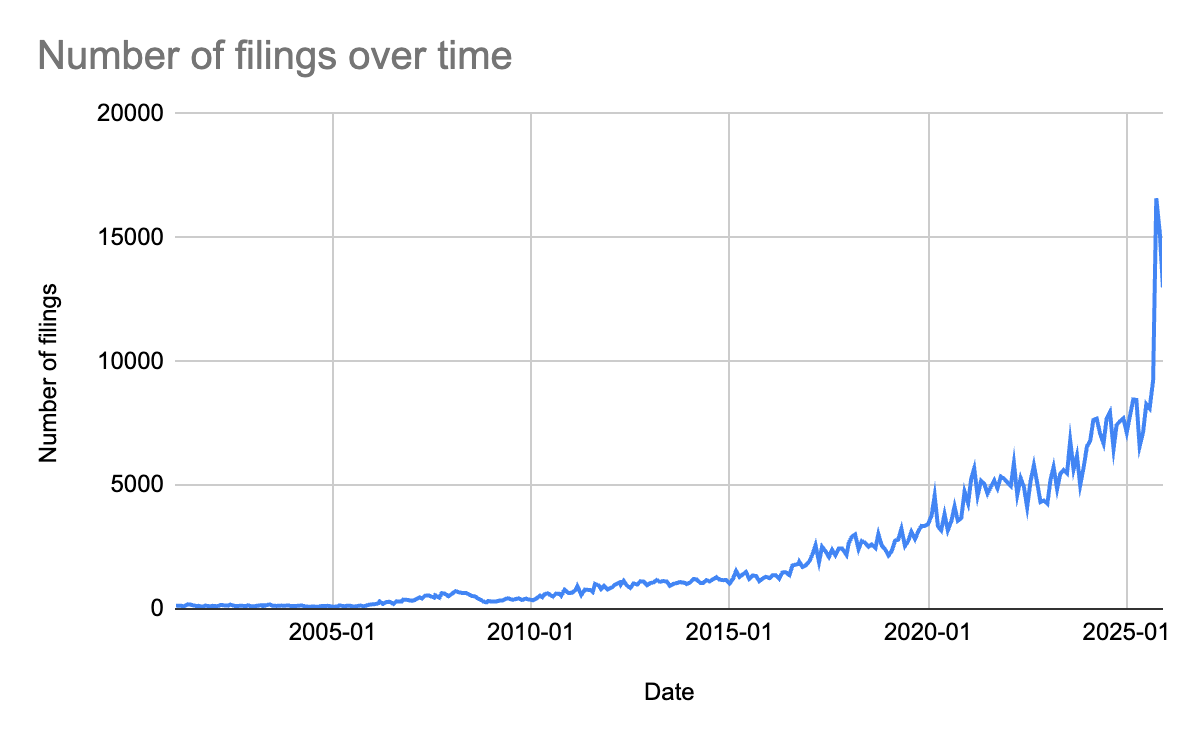
We've been watching the data on SEC Form 424B2 filings — the regulatory filings submitted every time a new structured product is issued — and the numbers are staggering.
In 2001, about 120 of these filings happened per month. Today, it's over 8,000. That's a 70x increase.
And almost nobody outside the industry is talking about it.
The numbers don't lie
From 2001 to 2005, the market was tiny. Around 120–130 filings a month. Then 2006 hit, filings more than doubled, and by early 2008 they peaked at 718 in a single month. Then the financial crisis happened.
Here's where it gets interesting. By 2012, the market had already surpassed its pre-crisis peak. The worst financial crisis in a generation barely dented the trajectory.
From 2013 to 2019, the market tripled. From 1,000 filings a month to over 3,000. Steady, relentless growth. The kind nobody writes headlines about because it doesn't crash or spike. It just compounds.
And then 2020 happened. We went from roughly 3,500 filings a month to regularly exceeding 7,000–8,000 by 2024 and 2025. The trend line is unmistakable. This market is accelerating.
Why this is happening
Rates stayed low for a very long time, and when you can't earn a decent yield on traditional bonds, structured notes suddenly become very attractive. The products themselves got better — multi-asset structures, ESG-linked products, cryptocurrency-linked notes. Every time a new asset class gains traction, someone wraps a structured product around it.
And digital distribution blew the doors open. The same democratization that happened with stock trading is now happening here. The barriers that kept people out — complexity, minimums, lack of information — are falling fast.
The gap is the opportunity
When monthly filings go from 120 to 8,000 in 24 years, that's not a cycle. That's a fundamental change in the architecture of capital markets. And the infrastructure hasn't caught up.
If you're a distributor trying to track 8,000+ new filings every month, you are drowning. The volume has grown so fast that most systems were built for a world with a fraction of this activity.
This market grew 70x in 24 years and it's still accelerating. The gap between the scale of the market and the quality of the infrastructure supporting it is enormous. That gap is where we live — and we think it's the biggest opportunity in structured products today.
We built our structured note reference data platform for exactly this problem: clean, complete, term-sheet-level data parsed directly from every 424B2 filing, delivered machine-ready so your team can stop reverse-engineering prospectuses and start making decisions.
Want more SQX updates? Follow SQX on LinkedIn and subscribe to our
LinkedIn
newsletter to stay ahead of the curve.
Latest News