Learn
Guides and explainers from the SQX team on municipal bonds, structured notes, fixed income, funds, alternative investments, and curves and derivatives. Company announcements and market news are on News.
109 items Clear filters
Measured Per Year Held, the Discount on Early-Called Structured Notes Runs 5 to 12 Points
Divided by the stated term, the gap between issue price and estimated value looks like a point or so a year. How often a client pays the short-life rate instead varies more than twofold by issuer.
The First Statement Value of a New Structured Note Depends on Its Issuer
FINRA prescribes a net-of-costs statement value for non-traded REITs. For a new structured note the first value follows the issuer's marking policy, and the policies land about three points apart.
Fund Holdings Are Filed By Portfolio. Investors Hold Share Classes.
The SEC receives fund holdings once per portfolio, while investors hold share classes with their own ISINs. The link from each share class to its portfolio decides how much of a fund book a holdings source can reach.
What Is Direct Lending? Middle Market Credit, Unitranche Loans, and the BDC Structure
Direct lending explained: how middle market loans are structured, what unitranche means, how BDCs hold private credit, and why these loans are hard to price.
What Is a Collateralized Loan Obligation ETF? A Practitioner's Guide to CLO ETFs
A practitioner's guide to CLO ETFs: what a collateralized loan obligation ETF holds, how the wrapper changes risk and liquidity, and how these funds are valued.
A fund's published expense ratio is a promotional price
The net expense ratio in the prospectus reflects a fee waiver the adviser can let expire. The gross expense ratio — the contractual cost — is the structural price, and the spread between the two is a deferred increase disclosed in plain view.
What Is a Leveraged Loan? A Practitioner's Guide to CLO Collateral
Learn what leveraged loans are, how the broadly syndicated market works, and why these senior secured, floating rate loans anchor all CLOs.
The largest hidden concentration in asset management is funds inside funds
Trillions of dollars in target-date and multi-asset funds report portfolios assembled from other funds. Resolve a level deeper and a handful of underlying index portfolios turn up across the entire market.
Investor timing costs more than the expense ratio
The management fee gets the headline. For many funds, the return investors actually earn falls well below the return the fund publishes, and the timing of flows in and out drives the difference — a wider drag than the fee.
Most bond fund risk numbers come from a partial portfolio
Duration, yield, and credit quality are the first three numbers a risk team pulls on a bond fund. All three are weighted averages computed from the slice of the portfolio where inputs exist — and for many funds that slice falls well short of the whole book.
Interval funds look like mutual funds until you try to redeem
Five types of SEC-registered funds share a statute. Their exit mechanics range from daily NAV to quarterly windows to exchange-only. The wrapper drives the risk more than the holdings do.
What a fund's redemption record reveals about liquidity risk
Redemption history measures behavior rather than composition. It records how much money left the fund, while a model merely predicts how fast money should leave.
What Is Structured Credit? A Practitioner's Guide to Securitized Products
Structured credit explained: how pooling, tranching, and payment waterfalls work across CLOs, CMBS, ABS, and the esoteric corner of the market.
Portfolio liquidity and share liquidity are distinct risks
In practice, the figure that protects a shareholder rarely emerges from the portfolio.
How stale is a fund's publicly disclosed portfolio
The lag in fund holdings disclosure follows from the reporting calendar working as designed.
What Is CLO Equity? A Practitioner's Guide to the Residual Tranche
A look at how CLO equity works: where the residual tranche sits, how quarterly distributions are paid, what interrupts them, and why the position is hard to value.
What Is a CLO? A Practitioner's Guide to Collateralized Loan Obligations
A practitioner's guide to collateralized loan obligations: capital structure, coverage tests, the deal lifecycle, CLO equity, and how tranche pricing is derived.
Servicing Structured Notes: The Lifecycle Events Behind the Term Sheet
A term sheet describes a structured note once. Servicing it means processing years of conditional events: coupons paid or missed, autocalls, resets, settlements.
Why share classes within a fund diverge in risk
The share class an investor owns, rather than the fund overall, often governs how a stress event reaches that investor.
Reverse Convertibles: High Coupons and the Downside That Pays for Them
A reverse convertible pays an above-market coupon because the investor has sold the issuer downside protection. The size of the coupon is the size of the risk.
Buffers, Barriers, and Downside Protection in Structured Notes
A buffer and a barrier can share a headline number and a reassuring word, and behave in opposite ways when the market falls.
Equity-Linked Notes: A Practitioner's Guide
Equity-linked notes are the core of the US structured note market. Let's look at what ELNs are, three choices that define them, and why individual stocks are surging.
Worst-Of Baskets: The Dispersion Risk Hiding in Multi-Index Structured Notes
Most multi-index structured notes are worst-of: their payoff depends only on the weakest index. Adding names adds risk, and dispersion decides how much it costs the holder.
Phantom Income on Structured Notes: What the Tax Classification Actually Tells You
Most classified structured notes generate phantom income: taxable income owed before any cash is received. The tax classification is what tells you which ones.
How to read leverage in a fund's reported exposure
The reconciling entry that makes the arithmetic work also reveals how much borrowing stands behind the exposure.
Where fund disclosure rules stop
The gaps in a fund's public record follow from the design of the rules, and knowing where they fall matters more than knowing they exist.
Autocallable Structured Notes: A Practitioner's Guide to the Observation Calendar
Most reference data on US structured notes captures the headline of the term sheet and stops. SQX's new feed covers 350,000+ notes at full term-sheet depth.
Municipal Bond Insurance: A Practitioner's Guide to Wraps, Insurers, and Pricing
This guide looks at how muni bond insurance works, who's writing it, what it does to spreads, and how to treat insured muni bonds in a pricing or portfolio workflow.
General Obligation vs. Revenue Bonds: A Practitioner's Guide to Municipal Bond Structures
Two muni bonds with matching ratings, maturities, and coupons can trade at different yields. Let's look at the difference between general obligation bonds and revenue bonds.
Bond trading on the SIX Swiss Exchange
How bonds trade on the SIX Swiss Exchange in Zurich, the types of bond listed and what draws international investors.
Pricing Uncertainty: Inside FX Option and Swaption Volatility Surfaces
Two of the deepest, most actively-quoted option markets in the world are foreign exchange options and interest rate swaptions. Let's dig into them.
Understanding Yield Curves: Swap, FX Forward, and Credit Default Swap Curves
Swap rate curves, FX forward curves, and CDS spread curves play key roles in derivatives pricing and risk management. Here's how they work and how SQX covers them.
Understanding Yield Curves: Global, Corporate, and Municipal Curves
Global sovereign curves, corporate credit curves, and municipal curves reflect different markets, different risks, and different use cases. Let's look closer.
How We Find the Real Problem Behind the Obvious Symptom
Learn how the 5 Whys method helps teams dig past surface-level symptoms to find root causes. A step-by-step guide to running smarter problem-solving sessions.
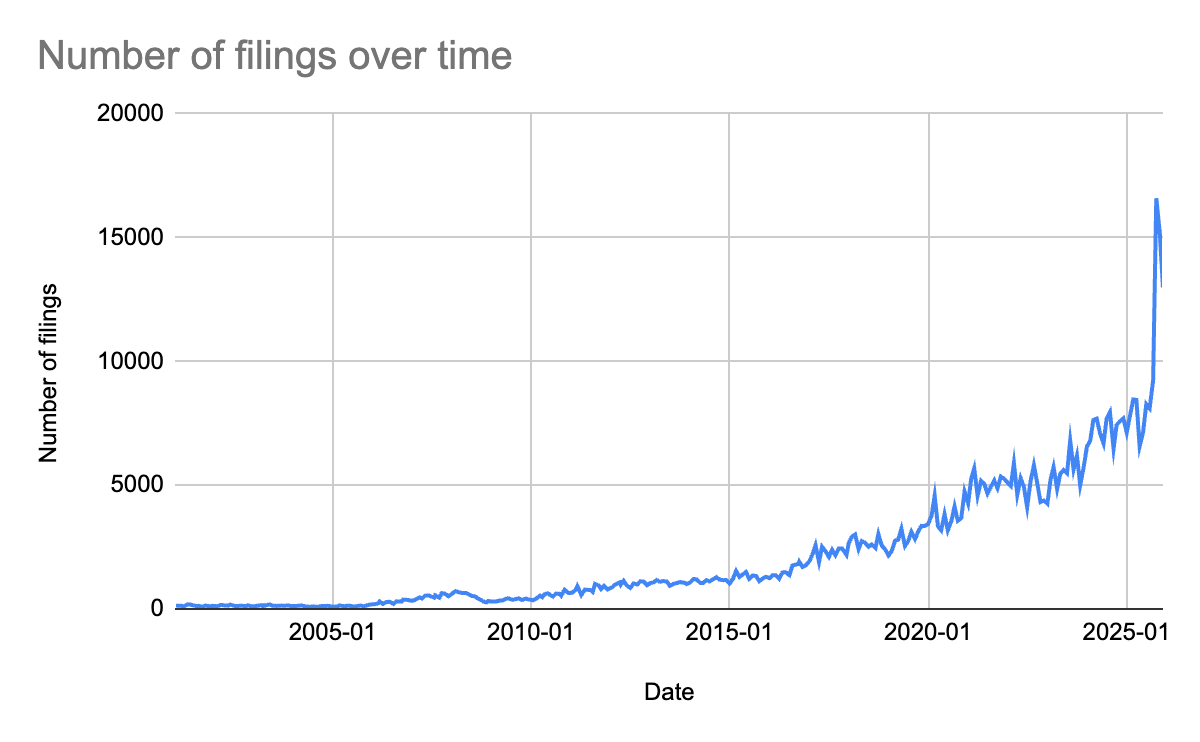
How structured products went from niche curiosity to 8,000 new filings a month — and why almost nobody is paying attention.
SEC structured product filings surged from 120 to over 8,000 per month in 24 years. Here's what's driving the growth — and why infrastructure can't keep up.
Understanding Syndicated Bank Loans and Green Bonds
Syndicated bank loans and green bonds are playing important roles for investors. It's worth taking a look at why these instruments matter and how they function.
Rethinking SWOT Analysis for Fintech’s Future: A More Human Approach
A traditional SWOT analysis can feel like it’s stuck in the present. At SQX, our upgraded approach to SWOT analysis is built for future action.
Understanding Catastrophe Bonds
Understanding and leveraging cat bonds can unlock unique opportunities for fixed-income portfolio construction.
SEC: Crypto Exposure Surveillance May No Longer Be Optional for Hedge Funds
SEC proposes requiring crypto exposure reporting from hedge funds. SQX crypto exposure data may be the cost effective solution.
Crypto Crash Exposes the Vulnerability of Institutional Assets: The Importance of Crypto Exposure Surveillance
Crypto Crash Exposes the Vulnerability of Institutional Assets.
Alternative Investments: An Overview
“Alternative investments” is defined by what it excludes. Public stocks, public bonds, and cash are traditional; nearly everything else gets the label. That…
Allocating to Alternatives
The question “how much should I allocate to alternatives?” is asked constantly and answered confidently, usually with a percentage range and a chart showing…
Alternative Investment Funds: The Vehicles
An investor deciding to allocate to private credit faces a second decision that matters nearly as much as the first: through which structure?
Private Markets: An Introduction
“Private markets” is a description of where an asset trades rather than what it is. A company is a company whether or not its shares are listed; a loan is a…
Liquidity Budgeting for Private Portfolios
Most portfolio construction treats liquidity as a property of individual assets, sorting them into those that can be sold and those that cannot. That framing…
Evergreen Funds: Perpetual Private Vehicles
An evergreen fund has no term, no capital call and no wind-up: money goes in at NAV, comes out at NAV subject to caps, and the fund continues indefinitely. How…
Interval Funds: How They Work
The mutual fund made a promise that defined it: bring your shares back any day and we will give you their value in cash. That promise is why mutual funds…
How Semi-Liquid Fund Repurchases Work
Semi-liquid vehicles — interval funds, tender offer funds, perpetual BDCs, NAV REITs and private evergreen funds — all provide liquidity through a periodic…
Semi-Liquid Funds, Explained
“Semi-liquid” is industry shorthand, not a regulatory category. It describes a liquidity profile — periodic and limited rather than daily or absent — and it…
Tender Offer Funds, Explained
Interval funds and tender offer funds look nearly identical from the outside. Both are registered closed-end funds. Both hold illiquid strategies. Both provide…
Interval Funds vs. Mutual Funds
Both are registered funds. Both are typically regulated investment companies issuing 1099s. Both are available without accreditation requirements at modest…
Non-Traded REIT Fees and Costs
Cost is the most persistent criticism of the non-traded REIT category, and it is the area where the sector has changed most. The vehicles sold fifteen years…
Non-Traded REITs: How They Work
A non-traded REIT is a real estate investment trust that registers its shares with the SEC like a public company but never lists them on an exchange. Investors…
NAV REITs: Perpetual Non-Traded REITs
The non-traded REIT of 2010 and the non-traded REIT of today are different products that share a name. The change was structural, it was driven by criticism…
Net Lease Investment, Explained
Most real estate investing is an operating business. Tenants come and go, roofs leak, taxes are appealed, and someone has to manage all of it. Net lease…
REIT Share Repurchase Programs and Gating
A non-traded REIT has no exchange listing, which means there is no buyer waiting when an investor wants out, and secondary transfers of unlisted interests are…
Non-Traded vs. Listed REITs
Put an office building, with its market, tenant, and financing unchanged, inside either of two REITs. The first trades on the New York Stock Exchange. The…
Real Estate Funds vs. Syndications
An investor with capital to allocate to private real estate faces a structural choice before any question about markets or property types: back a specific…
Preferred Equity in Real Estate
Between the senior loan and the common equity sits a layer that behaves like debt, is documented as equity, and gets used because it solves problems neither of…
Promote Structures and Waterfalls
Two syndications advertise the preferred return and the promote split at matching rates. Investors in the first receive substantially more than investors in…
Digital Infrastructure Investing
Digital infrastructure is the newest large category within infrastructure and fits the label least comfortably of any. A regulated water utility will be needed…
Infrastructure Investing: A Guide
Infrastructure is the least glamorous asset class in private markets and, for some investors, the most structurally appealing. The assets are pipes, wires…
Infrastructure Debt vs. Equity
An investor attracted to infrastructure faces a choice that determines their risk more than the choice of asset does: which part of the capital stack?
Co-Investment in Private Equity
A manager has a deal that is larger than its fund can comfortably take. Its concentration limits cap any position at a certain share of the fund. The deal is…
Continuation Vehicles in Private Equity
A fund is reaching the end of its life. An asset in it is performing well and the manager believes it has further to run. The fund cannot hold it indefinitely…
GP-Led Secondaries, Explained
The secondary market began as a place where investors sold interests they no longer wanted. The manager was a bystander whose only role was consenting to the…
Private Equity: How the Asset Class Works
Private equity is often described as an asset class. It is more accurately a set of ownership strategies bound together by a common structure: pooled capital…
The J-Curve in Private Equity
An investor commits to a private equity fund. Two years later the statement shows a loss. Nothing has gone wrong.
Private Equity Secondaries, Explained
A private equity commitment is supposed to be locked for a decade. The secondary market is where that turns out not to be strictly true — at a price.
Loan Covenants and Covenant-Lite Lending
A loan agreement has to solve a problem that arises the moment the money is disbursed: the lender’s capital is now inside someone else’s business, and the…
Direct Lending: Private Credit’s Core Strategy
Direct lending is the strategy most people mean when they say private credit: an investment fund negotiates a loan directly with a company, holds it on its own…
First Lien vs. Second Lien Debt, Explained
Lien priority is the most important word in a secured loan’s name. First lien and second lien describe the order in which lenders are repaid from a borrower’s…
How to Invest in Private Credit
The loans inside private credit portfolios are illiquid by nature — privately negotiated, unrated, held to maturity. All ways of investing in them therefore…
Private Credit: How Fund-Based Lending Works
Private credit is lending done by investment funds instead of banks. The fund raises capital from investors, negotiates loans directly with borrowers — most…
Mezzanine Debt: The Junior Layer, Explained
Mezzanine debt is the financing layer between senior debt and equity — the mezzanine floor of the capital stack. It exists because of a persistent gap: senior…
Private Credit Funds: Structures Compared
“Private credit fund” describes a strategy, not a structure. Two funds pursuing very similar lending — senior secured loans to middle-market companies, similar…
Private Credit Risks
Most writing about private credit risk is produced by people who manage private credit. That does not make it dishonest, and it does mean the risks tend to…
Unitranche Loans: A Combined Facility with Blended Risk
A unitranche loan collapses a borrower’s layered debt structure into a combined facility. Where a traditional deal stacks a first-lien term loan over a…
Private Credit vs. Bank Lending
For most of the twentieth century, a mid-sized company that needed a loan went to a bank. Increasingly, it goes to a fund. The borrower’s need has not changed…
Private Credit vs. High Yield Bonds
Both lend money to companies that cannot borrow at investment-grade rates. Both are held for income. Both frequently share a portfolio bucket. And an investor…
Evaluating a DST Investment: What to Examine
The pillar guide covers what a Delaware statutory trust is and how it fits a 1031 exchange. This article covers the harder question: with dozens of DST…
Delaware Statutory Trusts (DSTs): A Complete Guide
A Delaware statutory trust is, at its legal core, an entity formed under Delaware trust law: a trustee holds title to assets, and investors hold beneficial…
BDC vs. Private Credit Fund
An investor comparing a BDC with a private credit partnership is often not comparing two strategies. They may be comparing two wrappers around shared loans…
BDC Distributions and Return of Capital
A BDC yield is the number most investors look at and the number that tells them least. It says what is being paid. It says nothing about whether it is being…
Business Development Companies (BDCs)
Congress created the business development company in 1980 to solve a specific problem: smaller American companies could not easily raise capital, and the…
BDC Leverage and Asset Coverage
A BDC that lends at a given yield and borrows at a lower one earns the spread on borrowed money as well as on its own. That is the case for leverage, and it is…
Non-Traded and Perpetual BDCs
A listed BDC and a non-traded BDC can own loan portfolios that are nearly alike and deliver very different investor experiences. The difference is not the…
Alternative Investment Due Diligence
Allocations to alternative investments are decisions made with incomplete information about illiquid positions that cannot easily be reversed. Due diligence is…
Capital Calls: How They Work
A closed-end private fund raises money in a way that surprises people who come from mutual funds: at closing, investors hand over almost nothing. What they…
How to Choose a Fund Administrator
Selecting an administrator is among the few operational decisions a manager makes that are expensive to reverse. The administrator holds the fund’s books, its…
Distribution Waterfalls, Explained
When a private fund sends money to its investors, it runs the cash through a distribution waterfall rather than dividing it pro rata. The waterfall is an…
Distribution and DRIP Processing
Paying investors is the most visible thing a fund does. For an income-oriented product it is arguably the only thing many investors notice month to month…
The Due Diligence Questionnaire (DDQ), Explained
A due diligence questionnaire is the written backbone of fund due diligence: a structured set of questions through which an allocator asks a manager to state…
Fund Administration vs. Self-Administration
All funds must choose who keeps their books. The default answer in today’s institutional market is an independent third-party administrator, and that answer is…
Fund Administration for Alternative Investments
Investment funds run two operations at once. The first is the operation investors hear about: sourcing deals, managing assets, generating returns. The second…
Fund Expense Allocation: Who Pays for What
Private funds run on two pools of money: the management fee the manager receives to operate its business, and the fund’s own assets, which bear the costs of…
Investor Onboarding in Private Funds
Onboarding is the moment a fund converts an intention into an obligation. Before it, an investor is a prospect; after it, the investor is a limited partner…
Investor Reporting for Private Funds
An investor in a public security can look up its price. An investor in a private fund has to be told. Everything a limited partner knows about its position —…
NAV Calculation for Private Funds
The formula is short: assets minus liabilities equals net asset value, divided by units outstanding when a per-share figure is needed. If that were the whole…
Operational vs. Investment Due Diligence
An investment can fail because the strategy did not work. That is a risk investors accept knowingly; it is what they are being paid to bear.
Private Equity Fund Accounting, Explained
Private equity fund accounting is investment-company accounting applied to a vehicle that calls capital in installments, holds illiquid assets at…
Private Fund Administration: What’s Different
“Fund administration” covers everything from daily-dealing mutual funds to ten-year buyout partnerships, and the work differs more across that range than the…
Private Fund Audits: How to Prepare
The annual audit is the only time in the year when someone with no stake in the answer examines a private fund’s records. For a well-run fund it is a demanding…
Evaluating a Sponsor Track Record
A track record is the most prominent element in nearly all fund presentations, and it is among the least reliable. Most sponsors do not fabricate results. The…
Subscription Document Processing
Between an investor’s decision and their appearance in the register sits a stack of paper — or, increasingly, a structured digital workflow — that has to be…
Third-Party Due Diligence Providers
An independent broker-dealer with a few hundred advisors cannot staff an in-house team capable of examining all the sponsors and programs it might distribute…
Transfer Agency for Alternative Investments
Funds must resolve a deceptively simple question, continuously and accurately: who owns it? The response must be current and accurate to the unit, backed by…
What Does a Fund Administrator Do?
A fund administrator is the independent firm that keeps an investment fund’s official books, calculates its net asset value, maintains the register of who owns…
Bond Academy
A plain guide to bonds: how they pay, why their prices move with interest rates, the main types of bond and the risks bondholders take on.


























Nothing matches these filters. Clear filters